Chapter 6. 5G Spectrum and Open RAN

Updated: 3 days ago


6.1 Why These Two Topics Share a Chapter

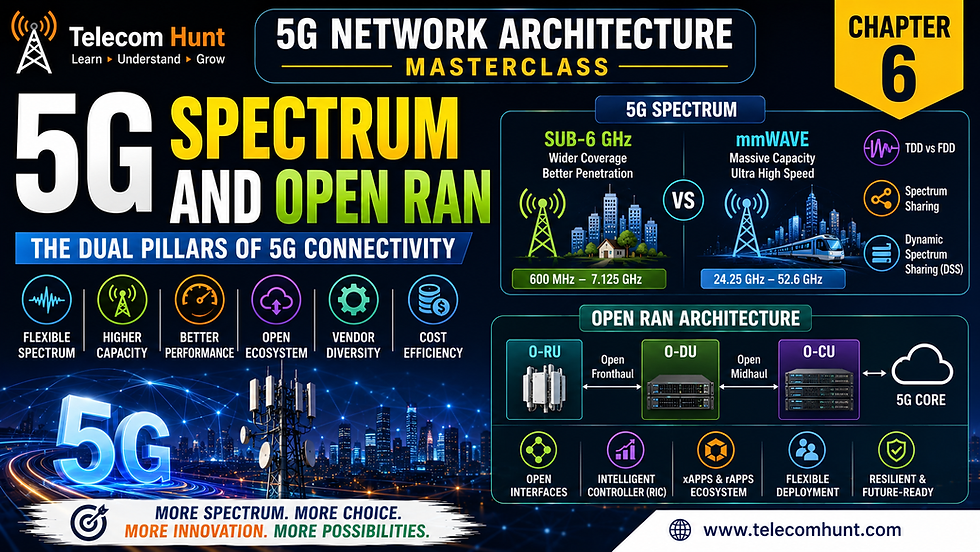
Figure 6.1: The six building blocks of this chapter.
What you will be able to explain by the end
What each spectrum tier is genuinely good for, and why the trade off cannot be engineered away.
Why millimetre wave deployed far less widely than early marketing suggested.
The difference between FDD and TDD, and why TDD makes synchronisation mandatory.
The O-RAN architecture, including both RIC controllers and the interfaces that join them.
What Open RAN actually changes commercially, including the costs it moves rather than removes.
Remember Spectrum is physics and cannot be negotiated. Open RAN is procurement and architecture, and it can. Keep those two halves separate in your head and the chapter stays simple. |
6.2 The Spectrum 5G Actually Uses

Figure 6.2: Three tiers, three completely different jobs.
Spectrum divides into three tiers, and each one exists to do a job the others cannot.
Tier | Range | Strengths | Practical role |
Low band | Below 1 GHz | Widest coverage, good building penetration, modest capacity | Rural and nationwide coverage |
Mid band | 1 to 6 GHz | The best balance, where massive MIMO delivers most gain | The capacity workhorse, most 5G traffic |
Millimetre wave | 24 GHz and above | Enormous bandwidth, very short range, blocked easily | Hotspots, venues and fixed wireless |
The constraint underneath all of it
Coverage and capacity pull in opposite directions. Lower frequencies travel further and carry less, because the channels available down there are narrow. Higher frequencies carry far more and travel far less.
That relationship has been true since 1G and no amount of engineering removes it. What 5G adds is the ability to use all three tiers together, with carrier aggregation and dual connectivity combining them for a single device.
Did You Know? Mid band is often called the golden band. It is where massive MIMO delivers most of its gain, and it carries the majority of 5G traffic worldwide, which is why mid band auctions attract the highest prices. |
6.3 Millimetre Wave, Promise and Reality

Figure 6.3: What it promises, and what it demands in return.
Millimetre wave deserves an honest treatment, because early 5G marketing oversold it and the deployment figures never matched the promises.
The promise is real
Up to 400 megahertz in a single carrier, multi gigabit throughput, very low air interface latency, and enormous capacity concentrated in a small area. Nothing about those claims is false.
So are the demands
Range is measured in hundreds of metres rather than kilometres. Beamforming is mandatory rather than optional, as Chapter 5 explained, because without it the path loss leaves no usable link. Walls, foliage and human bodies all block the signal. The consequence is many more sites, each needing fibre.
Where it works well | Why |
Stadiums and arenas | Thousands of users in one place, and the geography never changes |
Transport hubs | Dense demand in a fixed layout you can plan beams around |
Fixed wireless access | A mounted antenna with an engineered line of sight to the cell |
Common Misconception Millimetre wave was never going to blanket a country. It works where the geography is fixed and the demand is dense, and deployment volumes worldwide reflect exactly that. |
6.4 FDD and TDD, Two Ways to Share

Figure 6.4: Split by frequency, or split by time.
Uplink and downlink have to be separated somehow, and there are two mechanisms.
| FDD, split by frequency | TDD, split by time |
How it works | Uplink and downlink on separate bands | One band, alternating in time |
Simultaneous? | Yes, both directions at once | No, the radio switches direction |
Spectrum needed | A paired allocation | A single unpaired block |
Ratio control | Fixed by the band pairing | Configurable, usually favouring downlink |
Where it dominates | Low band, below 1 GHz | Mid band and millimetre wave |
Why TDD suits modern traffic
Traffic is heavily asymmetric, with downlink far exceeding uplink for most users. Because the TDD frame pattern is configurable, an operator can allocate more slots to downlink and match the actual demand. A paired FDD allocation cannot be rebalanced that way.
The obligation TDD creates
Every site sharing a TDD band must agree on the frame pattern and stay time aligned, normally using GPS or another precision timing source. If two neighbours transmit in opposite directions at the same instant, they interfere severely.
Important TDD synchronisation is not a tuning parameter, it is a precondition. Under certain atmospheric conditions that interference travels hundreds of kilometres, which is why regional frame patterns are often coordinated between operators. |
6.5 Getting More From Spectrum You Own

Figure 6.5: Four techniques, and what each one costs.
Buying more spectrum means an auction, and auctions are ruinously expensive. Every technique below exists to postpone that.
Technique | What it does | Trade off |
Dynamic spectrum sharing | LTE and NR share one carrier, allocated per slot | Costs efficiency on both sides, since neither gets a clean carrier |
Carrier aggregation | Combines several carriers under one node | Devices must support the specific band combination |
Spectrum refarming | Reassigns a band from an older technology | Only possible once traffic and devices have migrated away |
Supplemental uplink | Borrows a low band uplink to extend cell edge coverage | Helps the uplink direction only |
Supplemental uplink deserves a note. Uplink is usually what limits cell edge performance, because a handset transmits at a fraction of the power a base station does. Borrowing a low band uplink channel for a mid band cell addresses exactly that asymmetry.
Key Takeaway Spectrum is the most expensive asset an operator buys. Understanding these four techniques explains most of the radio planning decisions you will meet in practice. |
6.6 What Problem Open RAN Sets Out to Solve
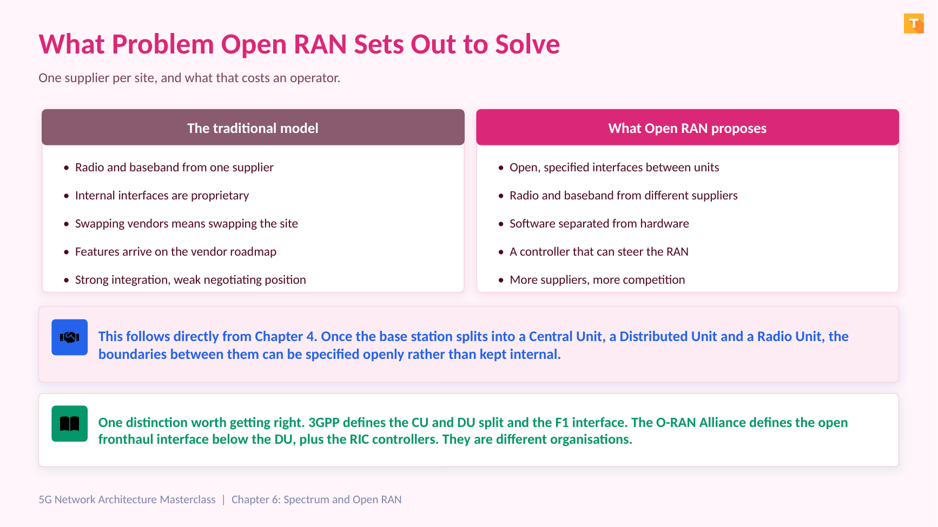
Figure 6.6: The traditional model, and what Open RAN proposes instead.
Open RAN is a response to a commercial problem rather than a technical shortcoming. The traditional radio access network works extremely well. The difficulty is the position it leaves the operator in.
The traditional model
Radio and baseband come from one supplier and the interfaces between them are proprietary. Replacing a vendor means replacing the site. New features arrive when that vendor decides. Integration is excellent, and the operator has a weak negotiating position.
What Open RAN proposes
Open, specified interfaces between the units, so radio and baseband can come from different suppliers. Software separated from hardware. A controller that can steer how the radio network behaves. More suppliers, and therefore more competition.
Important One distinction causes constant confusion. 3GPP defines the CU and DU split and the F1 interface. The O-RAN Alliance defines the Open Fronthaul interface below the DU, plus the RIC controllers. Different organisations, different scopes. |
6.7 The O-RAN Architecture

Figure 6.7: The familiar units, plus two controllers.
Most of this architecture is Chapter 4 with a prefix added. The O prefix simply indicates an O-RAN compliant version of a unit you already know.
Element or interface | Role |
O-RU, O-DU, O-CU | The radio, distributed and central units, built to O-RAN specifications |
Open Fronthaul | Connects the O-RU to the O-DU, specified by the O-RAN Alliance |
F1 and NG | Unchanged from 3GPP, joining O-DU to O-CU and O-CU to the core |
Near-RT RIC | Near real time controller, connected over E2, loops of 10 ms to 1 second |
Non-RT RIC | Non real time controller inside the SMO, sending policy over A1 |
O1 and O2 | Management and cloud orchestration from the SMO to every element |
The cleanest way to keep the two controllers straight is by speed. Near real time acts within a second, fast enough to influence scheduling and handover while a session is running. Non real time works more slowly, which is precisely when it can afford heavier analytics.
6.8 The Two Controllers, and What Runs on Them

Figure 6.8: Near real time and non real time compared.
Aspect | Near-RT RIC | Non-RT RIC |
Control loop | 10 ms to 1 second | Slower than 1 second |
Interface | E2 to the RAN | A1, policy down to the Near-RT RIC |
Where it sits | At the edge, close to the radio | Inside the SMO framework |
Applications | xApps | rApps |
Typical job | Traffic steering, admission control | Policy, model training, energy planning |
Data it uses | Live counters from E2 nodes | Historical data across the network |

Figure 6.9: Concrete examples of xApps and rApps.
What they actually do
Typical xApps include traffic steering, moving a user to a better cell before quality degrades, admission control deciding which sessions a loaded cell accepts, interference management coordinating neighbours, and QoS enforcement protecting a slice that is missing its target.
Typical rApps include energy saving, learning which cells can sleep and when, coverage optimisation retuning tilt and power from long term data, policy definition setting the goals xApps then pursue, and model training with models pushed down over A1.
Key Takeaway The relationship matters more than the lists. The non real time controller sets policy and trains models. The near real time controller executes against that policy, thousands of times faster. One thinks, the other acts. |
Important The application ecosystem is the least mature part of Open RAN. The interfaces and controllers exist, but a genuinely open marketplace of third party apps is still developing rather than established. |
6.9 Traditional RAN Compared With Open RAN

Figure 6.10: What changes, including the parts vendors skip.
Aspect | Traditional RAN | Open RAN |
Supplier per site | Normally one | Radio and baseband can differ |
Fronthaul interface | Proprietary or CPRI | Open Fronthaul from the O-RAN Alliance |
Intelligence | Inside vendor software | RIC controllers with xApps and rApps |
Hardware | Purpose built | Often commercial servers plus accelerators |
Integration effort | Carried by the vendor | Carried by the operator or an integrator |
Feature delivery | On the vendor roadmap | Potentially from several sources |
Maturity | Decades of field hardening | Improving, still less proven at scale |
The row that decides business cases
Read the integration row carefully. Open RAN moves work from the vendor to the operator, or to a systems integrator the operator pays. It does not remove that work, and the cost of carrying it is what most Open RAN business cases turn on.
Common Misconception Open RAN is often presented as simply cheaper. It changes where cost sits rather than eliminating it, trading equipment margin for integration effort and internal capability that the operator has to build and keep. |
6.10 What Goes Wrong in Practice

Figure 6.11: Four problems that reach an engineer.
Symptom | Likely cause | What to check |
TDD interference from far away | Neighbouring networks using different frame patterns, or atmospheric ducting | Frame configuration against neighbours, and correlation with weather |
Millimetre wave cell underperforms | Blocked line of sight, or beams that cannot reach the users | The physical path, before assuming a radio fault |
Multi vendor fronthaul will not interoperate | Both suppliers compliant, but with different optional parameters | That the exact O-RAN profile was agreed in procurement |
Nobody owns the fault | Three suppliers each pointing at another | Who integrates and who is accountable, decided before build |
Did You Know? Atmospheric ducting can carry a TDD signal hundreds of kilometres, well beyond its normal range. Interference that appears only in certain weather, or only in certain seasons, is a classic sign of it. |
6.11 Key Takeaways

Figure 6.12: The five points to carry forward.
Mid band does the work. Low band gives reach, millimetre wave gives hotspots, mid band carries the traffic.
TDD needs synchronisation. Every site must agree the frame pattern, or neighbours interfere.
Open RAN answers a commercial problem first, using the unit split from Chapter 4.
Two controllers, two speeds. Near real time acts within a second, non real time thinks for longer.
Integration effort moves from the vendor to the operator rather than disappearing.
Chapter 7 assembles the complete 5G System architecture end to end, from the device through the radio network and the core to the data network.
Frequently Asked Questions
Why can low band not simply carry more data?
Because the channels available below one gigahertz are narrow. That spectrum was allocated decades ago for other services, and what remains is fragmented. Capacity depends on channel width, so a narrow channel limits throughput regardless of how good the radio is.
Is millimetre wave a failure?
No, it is a specialised tool that was marketed as a general one. In stadiums, transport hubs and fixed wireless access it performs exactly as promised. The mistake was implying it would provide nationwide coverage, which its propagation characteristics never allowed.
What does the S slot in a TDD frame do?
It is the special or turnaround slot. The radio cannot switch instantly from transmitting to receiving, so a short guard period is needed. That slot contains the transition, and its length depends on how far away the most distant user is expected to be.
Is Open RAN the same as the CU and DU split?
No, though they are related. The CU and DU split is a 3GPP concept with the F1 interface between them, covered in Chapter 4. Open RAN adds the open interface between the DU and the RU, plus the RIC controllers, and is defined by the O-RAN Alliance.
Why does TDD interference travel so far?
Under certain atmospheric conditions a layer of air forms that guides radio signals along the surface with very little loss, which is called ducting. A signal that normally fades within a few kilometres can travel hundreds. Because TDD sites transmit and receive on the same frequency, a distant transmitter can arrive during a local receive slot.
How does supplemental uplink actually help?
A handset transmits at a small fraction of the power a base station does, so uplink usually limits cell edge performance. Supplemental uplink lets the device send on a low band channel with better propagation while continuing to receive on mid band, extending usable coverage without adding sites.
Can an operator mix FDD and TDD in the same network?
Yes, and most do. Low band FDD provides coverage while mid band TDD provides capacity, and carrier aggregation or dual connectivity combines them for a single device. The two duplexing schemes coexist without difficulty.
What is the SMO?
The Service Management and Orchestration framework. It hosts the Non-RT RIC and provides management through the O1 interface and cloud orchestration through O2. Think of it as the layer that manages and configures everything else, rather than something in the traffic path.
Why is the Near-RT RIC loop bounded at one second?
Because faster than about ten milliseconds belongs to the scheduler inside the DU, and slower than a second stops being useful for decisions affecting an active session. That window is where an external controller can influence behaviour without needing to sit in the real time scheduling path.
What does the E2 interface actually carry?
It carries two things. Reports from the RAN node to the Near-RT RIC, covering measurements and events, and control or policy messages back. The functions exposed are grouped into service models, and which service models a node supports determines what an xApp can actually do with it.
Why does multi vendor fronthaul interoperability remain difficult?
The Open Fronthaul specification contains options, and compliance does not mean two implementations chose the same options. Category A and B radios differ in where beamforming is performed, and parameters such as compression and timing can be implemented differently. Both vendors can be fully compliant and still fail to interoperate.
Does Open RAN require virtualised or cloud native hardware?
Not strictly, but in practice they travel together. Open RAN separates software from hardware, and the natural way to run that software is on commercial servers, often with accelerator cards for the physical layer. The terms vRAN and Open RAN overlap heavily but are not identical, since a vRAN can still be single vendor.
Scenario Based Questions
An operator holds only mid band spectrum. What coverage problem follows?
Cell edge and indoor coverage, particularly on the uplink. Mid band propagates well enough for urban capacity but does not penetrate buildings like low band. The usual answers are supplemental uplink, more sites, or acquiring low band spectrum, and the last is normally the most expensive.
A regulator releases unpaired mid band spectrum. What does that imply?
It implies TDD, since an unpaired block cannot support frequency division duplex. That in turn implies a synchronisation obligation, and typically a regionally coordinated frame pattern so neighbouring operators do not interfere with each other.
An operator wants Open RAN to cut costs. What should they plan for first?
Integration capability. The equipment may cost less, but the operator now carries work the vendor used to carry, including interoperability testing, fault isolation across suppliers and lifecycle management. Without that capability, or a paid integrator, the saving does not materialise.
Troubleshooting Based Questions
Interference appears on a TDD cell only in summer evenings. What is happening?
That pattern strongly suggests atmospheric ducting. Temperature inversions form in settled weather and can guide a distant signal into your receive slots. Confirm by checking whether the affected sites face a distant network across open ground or water, and whether the timing correlates with weather rather than traffic.
An O-RU and O-DU from different vendors will not bring the link up. Where do you start?
Compare the Open Fronthaul profiles and parameter sets on both sides before anything else. Check the category of the radio unit, the compression settings and the timing configuration. This is a configuration mismatch far more often than a fault in either product.
Architecture-Based Questions
Where do xApps get their data from?
From the RAN nodes over the E2 interface, through the service models those nodes expose. An xApp subscribes to reports and receives measurements and events as they occur, which is what allows it to act inside its control loop rather than after the fact.
How do the RIC controllers relate to the NWDAF in the core?
They occupy the same conceptual space in different domains. The RIC controllers apply analytics and control to the radio access network, while the NWDAF, covered in Chapter 19, does so for the core. Both collect data, produce insight and drive automated decisions in their own domain.
If Open RAN opens the fronthaul, why keep F1 as a 3GPP interface?
Because F1 was already an open 3GPP specification from Chapter 4, so there was nothing to open. The gap was below the Distributed Unit, where the interface to the radio had historically been proprietary or CPRI. The O-RAN Alliance addressed that gap rather than duplicating existing work.
Standards Referenced in This Chapter
Document | Subject |
3GPP TS 38.104 | NR base station radio transmission and reception, including band definitions |
3GPP TS 38.101 | NR user equipment radio transmission and reception, FR1 and FR2 bands |
3GPP TS 38.213 | NR physical layer procedures for control, including TDD slot format indication |
3GPP TS 38.401 | NG-RAN architecture, the CU and DU split that Open RAN builds on |
O-RAN Alliance | Open Fronthaul specification, the interface between the O-DU and the O-RU |
O-RAN Alliance | Near-RT RIC and E2 interface, and Non-RT RIC with the A1 interface |
The full 3GPP specification archive is available at 3gpp.org specifications. O-RAN Alliance specifications are published separately at o-ran.org.
End of Chapter 6. 5G Spectrum and Open RAN
5G Network Architecture Masterclass.
------------------------
Learn Telecom. Crack Interviews. Build Careers.
support@telecomhunt.com | (c) 2026 Telecom Hunt, All rights reserved.


Comments