Chapter 3. 3GPP Releases and 5G Deployment Options

Updated: 2 days ago


Chapter 3. 3GPP Releases and 5G Deployment Options
3.1 From Specification to Live Network

Figure 3.1: The six building blocks of this chapter.
What you will be able to explain by the end
How a IMT study item becomes a technical specification, and what a freeze actually means.
What each release from 15 to 19 delivered, and why capability arrives in waves.
The real difference between Non Standalone and Standalone, which is not the radio.
Every deployment option from 1 to 7, read as two simple questions.
Why the two core networks coexisted for years, and how N26 made that possible.
Remember A release is a date, not a product. Anything not ready by the freeze waits for the next release, which is why 5G capability arrived in stages rather than all at once. |
3.2 How 3GPP Turns an Idea Into a Specification

Figure 3.2: Study item, work item, freeze, then implementation.
3GPP organises work in two stages before anything gets built. A study item asks whether an idea is feasible and normally produces a Technical Report, written as TR followed by a number. If the answer is yes, a work item specifies how it works and produces a Technical Specification, written as TS.
Why the freeze matters commercially
Stage 3 freeze is the point at which protocol details stop changing. That date matters far more than it sounds, because no vendor commits to silicon or a software baseline while the specification is still moving. The freeze is what lets the supply chain start.
The consequence is that features arrive in waves. A capability that misses the freeze does not appear late in the same release, it appears in the next one, typically eighteen months or more later.
Specification reference: 3GPP specification numbering and release information
Did You Know? A Technical Report is numbered in the TR series and a Technical Specification in the TS series. When someone quotes TS 23.501 they are citing a normative specification. A TR is a study, and implementing against one is a mistake. |
3.3 The Release Timeline, 15 Through 19

Figure 3.3: What each release delivered, and roughly when it froze.
Read this timeline as capability waves rather than product launches. Each release closed with a defined scope, and equipment followed later.
Release | Froze | Character | Headline content |
Release 15 | 2018 | First 5G release | New Radio, the 5G System in TS 23.501, NSA specified before SA |
Release 16 | 2020 | 5G phase two | URLLC enhancements, V2X, industrial IoT, improved positioning |
Release 17 | 2022 | Reach and efficiency | RedCap devices, non terrestrial networks, slicing improvements |
Release 18 | 2024 | 5G-Advanced begins | AI and machine learning in the RAN, energy saving, duplex evolution |
Release 19 | Ongoing | 5G-Advanced continues | AI native design, further NTN work, early studies feeding 6G |
One detail worth remembering about Release 15
Release 15 specified Non Standalone before Standalone. That ordering was deliberate and commercial. Operators needed a way to launch 5G quickly using the core network they already owned, and the standard accommodated that.
Important These are freeze dates, not launch dates. Commercial equipment normally appears twelve to eighteen months after a release freezes, so the network you operate today usually sits a release or two behind the newest specification. |
3.4 Non Standalone and Standalone, The Real Difference

Figure 3.4: NSA anchors the session in the EPC. SA runs it in the 5G Core.
This is the most commercially important distinction in the chapter, and it is routinely misunderstood. The difference is not how much 5G radio is deployed. It is which core network terminates the session.
What happens in Non Standalone
The device attaches to an LTE anchor. The eNodeB carries the control plane and the gNodeB is added alongside it as a secondary node using dual connectivity, contributing extra throughput. Everything terminates in the Evolved Packet Core.
What happens in Standalone
The device attaches directly to the gNodeB and the session is managed by the 5G Core. One radio, one core, and a completely different capability set becomes available.
Aspect | Non Standalone | Standalone |
Control plane anchor | LTE eNodeB | gNodeB |
Core network | Evolved Packet Core | 5G Core |
Role of the 5G radio | Added capacity through dual connectivity | Carries the whole session |
Network slicing | Not available | Available |
Edge user plane | Not available | Available |
Network exposure | Limited to SCEF | NEF with standard APIs |
Voice | VoLTE over the EPC | EPS fallback, then VoNR |
Common Misconception If the session is anchored in the Evolved Packet Core it is Non Standalone, no matter how much 5G radio is involved. Slicing, edge placement and exposure all live in the 5G Core, so Non Standalone cannot offer them at any price. |
3.5 Deployment Options 1 to 7 Without the Confusion

Figure 3.5: Every option read as two questions, which radio and which core.
The option numbers intimidate people unnecessarily. Every one of them answers just two questions. Which radio anchors the control plane, and which core terminates the session.
Option | Radio | Core | What it means in practice |
Option 1 | LTE only | EPC | Classic 4G, the starting point for every operator |
Option 2 | NR only | 5GC | Standalone 5G, the destination architecture |
Option 3 | LTE anchor plus NR | EPC | The common first launch, reusing the existing core |
Option 4 | NR anchor plus LTE | 5GC | NR carries control while LTE adds capacity |
Option 5 | LTE only | 5GC | LTE radio connected to the 5G Core, core migrated first |
Option 7 | LTE anchor plus NR | 5GC | Like Option 3 but with the core already migrated |
What the letters after an option number mean
Options 3, 4 and 7 have sub variants such as 3a and 3x. Those letters describe only where the user plane splits between the two radios, which matters for transport planning and for how much traffic crosses each backhaul link. The fundamental architecture question is unchanged.
If you are wondering about Option 6, it was studied and dropped, which is why you will never meet it in a live network.
Remember Option 3x was the most common first launch worldwide. Option 2 is where the industry is heading. Almost every migration conversation is about the distance between those two. |
3.6 The Migration Path Operators Actually Walked

Figure 3.6: Three stages, spread across several years and budget cycles.
Migration was a commercial story as much as a technical one, and it ran in three stages.
Launch fast on Non Standalone, usually Option 3x. This reused the existing Evolved Packet Core, added New Radio for capacity, and put the 5G indicator on handsets.
Introduce the 5G Core in parallel rather than replacing anything. Set up interworking with the EPC and start Standalone service in dense urban areas and for enterprise customers.
Move to Standalone everywhere. Slicing and edge deployment become real, and voice over New Radio replaces EPS fallback. The EPC is normally retained for legacy devices rather than switched off.
Why nobody skipped stage one
Non Standalone generated years of marketing and revenue while the 5G Core was still being built and tested. In most markets, stage one funded stages two and three. Any migration plan that ignores that funding sequence is a plan that never gets approved.
Key Takeaway The industry did not choose Non Standalone because it was technically better. It chose it because it was available first and reused a core network that already worked. |
3.7 How the EPC Evolved Towards the 5G Core

Figure 3.7: The two cores coexist, joined by N26 interworking.
The core network did not get replaced. It got a sibling. A dual capable device can reach both radios, and each radio leads into its own core, with both paths ending at the same data network.
EPC element | 5G Core equivalent | Role during migration |
MME | AMF | Linked by N26 so a session survives moving between cores |
S-GW and P-GW | SMF and UPF | Control and user plane separated on the 5G side |
HSS | UDM with UDR | The UDM fronts the HSS so subscriber data is shared, not duplicated |
PCRF | PCF | Policy moves onto the service based interface |
IMS over EPC | IMS over 5GC | Voice migrates last, through EPS fallback to VoNR |
The interface that made coexistence work
N26 connects the MME and the AMF. It is what allows a session to survive when a device moves between the two systems, and it is specified in the interworking clause of the 5G System architecture.
Specification reference: 3GPP TS 23.501, System architecture for the 5G System, clause 5.17 on interworking
Important There was never a cut over night. The two cores ran side by side for years, and in most networks they still do, because legacy devices never retire on the schedule the plan assumed. |
3.8 Why Voice Was the Hardest Part

Figure 3.8: EPS fallback redirects a call to LTE while VoNR matures.
Voice caught many operators out. In an early Standalone network the 5G Core was live but voice over New Radio was not ready, so the network fell back.
How EPS fallback actually behaves
The device requests an IMS voice call. The AMF recognises the request and triggers a redirection to LTE, and the call then runs as VoLTE over the Evolved Packet Core. It works, and it was the interim answer almost everywhere.
The costs are real though. Call setup takes longer because of the redirection step, and the mechanism quietly depends on having LTE coverage everywhere you have 5G. Lose that assumption and calls fail in exactly the places 5G was newly deployed.
What VoNR changes
Voice over New Radio keeps the call on the 5G radio and requires IMS integrated with the 5G Core. It removes the redirection and the LTE coverage dependency, and it arrived considerably later than most roadmaps promised.
Key Takeaway Voice is the service subscribers notice first, so a migration plan that breaks voice does not survive contact with customers. Protect it before optimising anything else. |
3.9 4G Deployment Compared With 5G Deployment

Figure 3.9: Same industry, very different rollout mechanics.
Aspect | 4G rollout | 5G rollout |
Starting point | Replaced 3G over time | Added beside LTE, which stays in service |
First launch mode | A single architecture | Non Standalone first, Standalone later |
Core network | EPC from day one | EPC first, 5G Core added afterwards |
Spectrum | Mostly sub-3 GHz | Sub-6 GHz coverage plus mmWave hotspots |
Site strategy | Macro coverage led | Macro plus dense small cells for capacity |
Voice | CSFB, then VoLTE | EPS fallback, then VoNR |
Enterprise role | Largely consumer led | Private networks and slices from the start |
Notice the voice row. The pattern repeats exactly: an interim fallback mechanism first, then a native solution once the new core matures. Engineers who lived through CSFB found EPS fallback familiar for good reason.
Remember The defining difference across every row is that 5G was added alongside a working network rather than replacing one. That single fact explains most of the complexity in this chapter. |
3.10 Choosing an Option, and What Goes Wrong
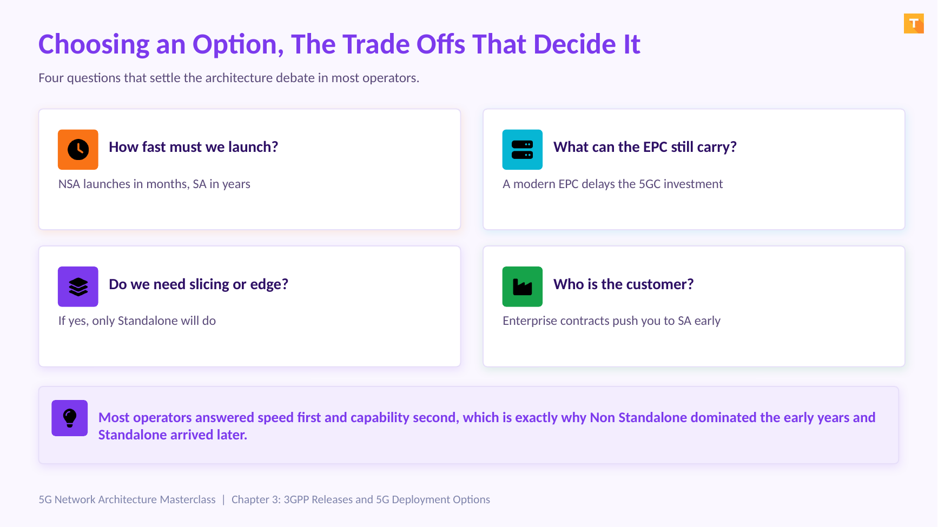
Figure 3.10: Four questions that settle the architecture debate.
In practice the architecture debate comes down to four questions. How fast must we launch, what can the existing EPC still carry, do we need slicing or edge, and who is the customer.
Launch speed favours Non Standalone because it reuses a working core. A recently modernised EPC argues for delaying the 5G Core investment. But if slicing or edge computing is required, the debate ends immediately, because those capabilities exist only in the 5G Core. And an enterprise contract with isolation or latency terms simply cannot be met on Non Standalone.

Figure 3.11: Four failures that appear on real migration projects.
Four failures worth recognising
Symptom | Likely cause | What to check |
Device shows 5G but performs like 4G | Non Standalone with a weak NR leg, so throughput comes mostly from LTE | Dual connectivity status and secondary cell addition rate |
Calls drop when moving between cores | N26 interworking missing or misconfigured | The N26 interface between the MME and the AMF |
Voice setup slow on Standalone | EPS fallback redirecting every call back to LTE | Whether VoNR is enabled and IMS is integrated with the 5GC |
Slicing sold but undeliverable | The network is still Non Standalone, so no 5G Core exists | The deployment option, before promising any slice based service |
3.11 Key Takeaways

Figure 3.12: The five points to carry forward.
A release is a date, not a product. Features that miss the freeze wait for the next release.
Non Standalone and Standalone differ in the core, not the radio. If the session ends in the EPC, it is Non Standalone.
Every deployment option is two questions. Which radio anchors the control plane, and which core terminates the session.
Migration was staged and never a cut over. The two cores ran side by side, joined by N26 interworking.
Only Standalone unlocks slicing, edge deployment and network exposure.
Chapter 4 opens the NG-RAN itself, including the central unit and distributed unit split that reshaped what a base station actually is.
3.12 Frequently Asked Questions
What does it mean when people say a release is frozen?
Freeze is the point at which the specification content stops changing for that release. Stage 3 freeze in particular means the protocol details are final. Vendors need that certainty before committing to silicon and software baselines, so the freeze is effectively the starting gun for the supply chain.
Is Non Standalone real 5G?
It uses genuine 5G New Radio, so the radio is real. What it does not use is the 5G Core, which means slicing, edge user plane placement and network exposure are unavailable. Calling it real 5G depends entirely on whether you mean the radio or the capability set.
Why does my phone show 5G when the speed is no better?
On Non Standalone the indicator appears once a 5G leg is added through dual connectivity. If that leg is weak or lightly loaded, most of your throughput still comes from the LTE anchor, so the indicator changes while the experience does not.
What happened to Option 6?
It was studied and then dropped. It described New Radio connected to the Evolved Packet Core, which offered little benefit over the alternatives and created work for a core network that was already being replaced. You will not meet it commercially.
What is the difference between Option 3, 3a and 3x?
All three are Non Standalone with an LTE anchor and the EPC. The letters describe where the user plane splits. In Option 3 the split happens at the eNodeB, in 3a the user plane goes directly from each node to the core, and in 3x the split moves to the gNodeB. The choice affects backhaul dimensioning rather than architecture.
Why would anyone deploy Option 5?
Option 5 connects LTE radio to the 5G Core. It suits an operator that wants to migrate the core first, gaining service based architecture and slicing capability, while the radio estate catches up. It is uncommon but entirely rational when the core is the older asset.
What exactly does N26 carry?
N26 is the interface between the MME and the AMF, and it carries the context needed to move a session between the Evolved Packet Core and the 5G Core. Without it, interworking falls back to a slower method where the session is re established rather than transferred, which users experience as a gap.
Does Standalone require new spectrum?
No. Standalone is a core network and anchoring question, not a spectrum question. An operator can run Standalone on existing mid band spectrum. Dynamic spectrum sharing even allows LTE and New Radio to share the same carrier, though it costs some efficiency.
Why did 3GPP specify Non Standalone before Standalone?
Commercial pressure. Operators wanted to launch 5G quickly using the core they already owned, and vendors wanted an early market. Specifying NSA first in Release 15 allowed launches years before the 5G Core was mature, which is also why so much early 5G marketing described radio performance rather than new services.
What is EPS fallback doing at the protocol level?
When the UE requests an IMS voice session on a Standalone network without VoNR, the AMF triggers a release with redirection or a handover to LTE. The device then establishes the call as VoLTE through the EPC and IMS. The added delay comes from that transition, not from IMS itself.
Can an operator run Standalone and Non Standalone at the same time?
Yes, and most do during migration. Devices are directed to one or the other through configuration and subscription, and N26 interworking handles movement between the two. Operating both increases test and assurance effort considerably, which is a real cost that plans often understate.
How does dual connectivity split traffic between LTE and NR?
In Non Standalone the device maintains a master node, the eNodeB, and a secondary node, the gNodeB. A split bearer allows a single data flow to use both legs, with the scheduler deciding the ratio. This is why NSA throughput depends on the quality of both radios rather than the 5G one alone.
Scenario-Based Questions
An operator wants slicing for an enterprise customer next quarter. Is that feasible on their NSA network?
Not as a genuine slice. Slicing is a 5G Core capability defined by the S-NSSAI, and the EPC has no equivalent. You can offer APN based differentiation with prioritisation, but you cannot offer isolation or a slice specific performance contract until Standalone is deployed for that customer.
A regulator requires 5G coverage figures. Which architecture counts?
It depends on the definition the regulator publishes, which is exactly why this becomes contentious. Some definitions count any 5G New Radio coverage, which includes Non Standalone. Others require Standalone or a minimum performance level. Always confirm the definition before reporting a number.
Your EPC was modernised two years ago. Does that change the migration plan?
Yes, materially. A recently modernised EPC has remaining book value and capability, which strengthens the case for staying on Non Standalone longer and deploying the 5G Core selectively for enterprise and dense urban areas rather than everywhere at once.
Troubleshooting Based Questions
Standalone devices attach successfully but data sessions fail. Where do you look?
Registration succeeded, so the AMF, AUSF and UDM path is working. The failure is in session establishment, so check the N11 interface to the SMF, the N4 association between the SMF and the UPF, and the DNN configuration for that subscriber.
Handover from 5G to LTE fails only for some subscribers. What differs?
Check subscription data first, since interworking behaviour can depend on the subscribed slice and DNN. Then check whether those subscribers are being served by a UPF or AMF instance without a properly configured N26 path, because partial configuration across a pool produces exactly this pattern.
Architecture-Based Questions
Where does the deployment option actually get configured?
It is not a single setting. The option emerges from how the radio is configured for dual connectivity, which core the base station is connected to, and what the subscriber is permitted to use. That is why deployment option questions cannot be answered by looking at one node.
Does moving to Standalone require replacing the RAN?
Not necessarily. A gNodeB that supports both can connect to the EPC in Non Standalone and to the 5G Core in Standalone, often through software configuration. What usually forces hardware change is spectrum, capacity or the move towards a central unit and distributed unit split, which Chapter 4 covers.
When can the EPC finally be switched off?
When no device or service still depends on it, which in practice means when the last LTE only devices are retired and voice has fully migrated to VoNR. For most operators that is a slow process measured in years, and many will keep the EPC running well beyond their own forecasts.
Standards Referenced in This Chapter
Document | Subject |
3GPP TS 23.501 | System architecture for the 5G System, including clause 5.17 on interworking |
3GPP TS 23.502 | Procedures for the 5G System, including EPS fallback and handover |
3GPP TS 23.401 | EPS architecture for E-UTRAN access, the Evolved Packet Core specification |
3GPP TS 37.340 | Multi connectivity, the specification behind dual connectivity and NSA |
3GPP Release 15 | First 5G release, specifying Non Standalone and then Standalone |
3GPP Release 17 | Introduces Reduced Capability devices and non terrestrial networks |
3GPP Release 18 | Opens the 5G-Advanced era |
The full 3GPP specification archive is available at 3gpp.org specifications. Always check the release version that matches your deployment.
End of Chapter 3. 3GPP Releases and 5G Deployment Options
5G Network Architecture Masterclass.
------------------------
Learn Telecom. Crack Interviews. Build Careers.
support@telecomhunt.com | (c) 2026 Telecom Hunt, All rights reserved.


Comments