5G Network Architecture Options Explained (Option 1 to Option 7)
- May 3
- 10 min read
5G Network Architecture Options
Introduction

5G is often marketed as faster than 4G, but the real innovation lies in its architecture. Unlike previous generations, 5G was not designed as a single upgrade path. Instead, it introduced multiple deployment options so operators can evolve their networks based on business priorities, legacy infrastructure, and investment strategy.
In 3GPP Release 15, seven architecture options were defined. While all options are technically valid, only a few have seen real-world adoption.
This blog breaks down each option in a simple and practical way, with clear explanations of what it means and why it matters.
Why Multiple 5G Architecture Options Exist
Telecom operators have spent billions building 4G LTE networks. A complete replacement was neither practical nor economically viable.
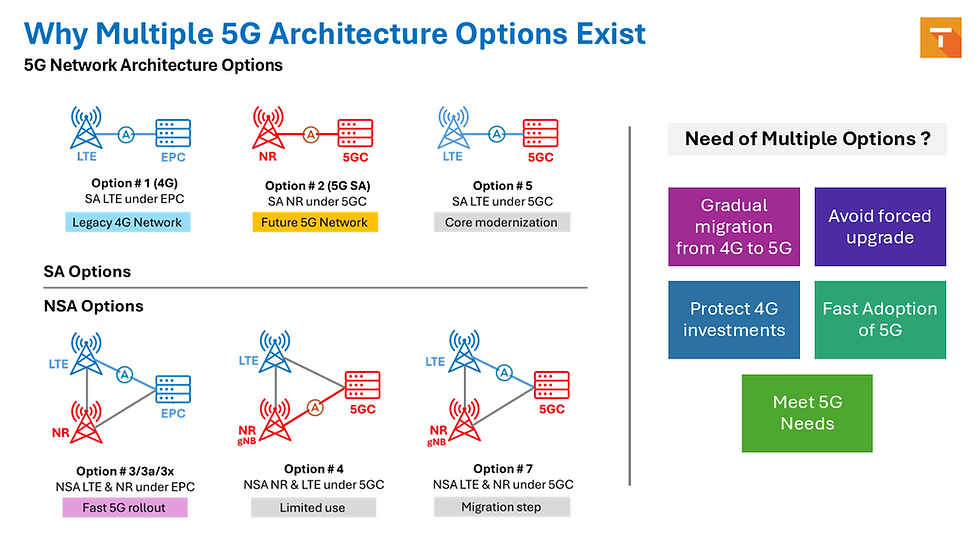
To solve this, 3GPP introduced multiple architecture options to:
• Enable gradual migration instead of a forced upgrade
• Protect existing 4G investments while introducing 5G
• Allow faster time-to-market for early 5G services
• Support biggest use case of 5G on priority which is mobile broadband
This flexibility is one of the key reasons why 5G adoption has been faster than previous generations.
Standalone (SA) Architecture

Options 1, 2, and 5 share a common foundation as Standalone (SA) architectures because they are all anchored on use of One Radio Only.
As visible on Screen , Option # 1 is Legacy 4G Network while Option # 2 & Option # 5 are using 5G Core . This 5G Core enables a more flexible and future-ready network design.
The 5G core network is built on a cloud-native, service-based architecture (SBA) that supports virtualization, containerization, and automated orchestration.
Non-Standalone (SA) Architecture
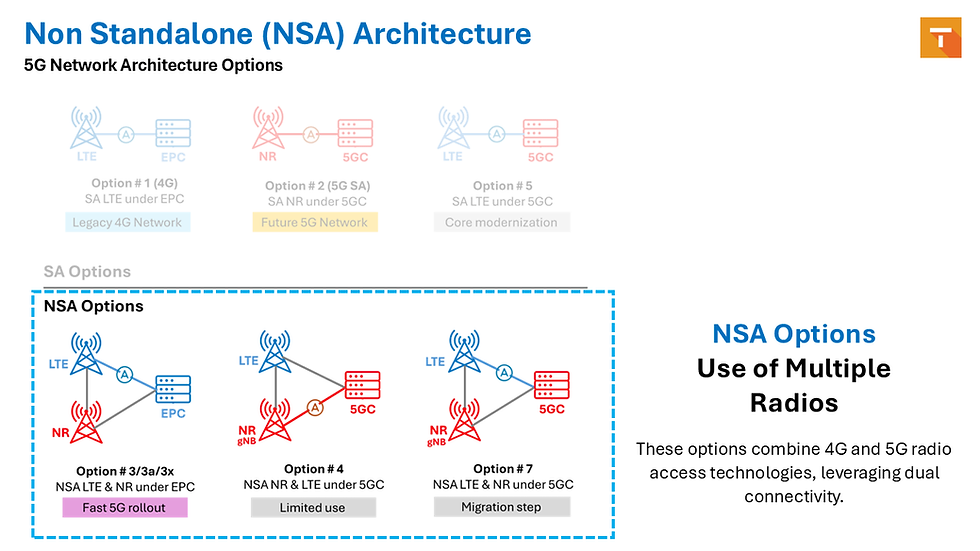
Non-Standalone (NSA) architecture integrates 5G NR with existing 4G LTE infrastructure, enabling faster rollout.
This approach minimizes deployment cost and complexity while accelerating early 5G adoption, though it remains dependent on the 4G network.
Option # 1 ( Pure 4G LTE Network )
Option #1 refers to a pure 4G LTE architecture which doesn’t have any linkage with 5G . This is defined in 3GPP as a baseline for evolution.
• It represents the existing 4G network.
• It consists of LTE radio (E-UTRAN) connected to the Evolved Packet Core (EPC).
• There is no 5G NR or 5G Core (5GC) in this option.

As you can see on Screen , S1C is used for control plane & S1U is used for User Plane traffic between Radio & Core.
In simple terms: Option 1 = legacy 4G LTE network, used as the foundation to introduce NSA 5G deployments via dual connectivity.
Option # 2 ( 5G SA Architecture )
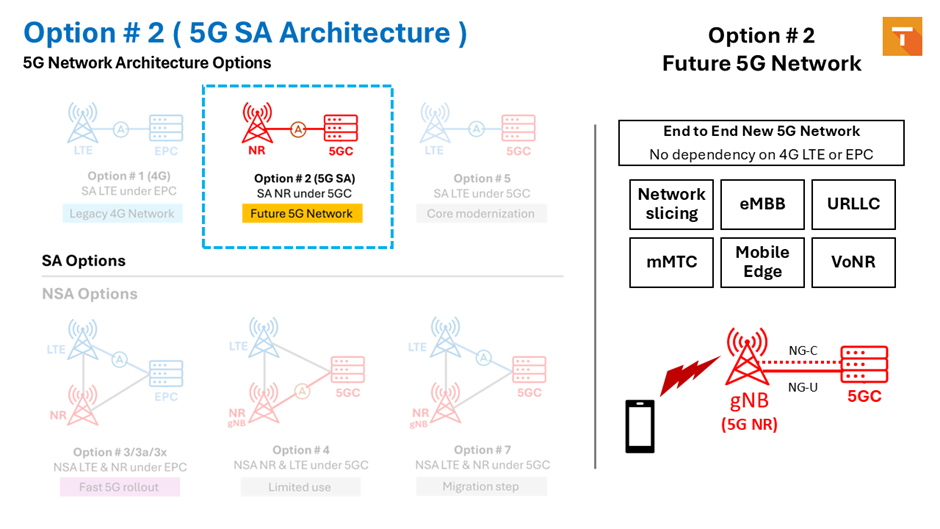
Option 2 is the Standalone (SA) 5G deployment architecture, which means it is a pure 5G network without depending on 4G at all.
What Option 2 Means ?
As visible in Diagram , In Option 2, both the radio network and the core network are 5G. The device connects directly to a 5G base station (gNodeB), and all traffic is handled by the 5G Core (5GC) instead of the older 4G EPC. In this Option , There is No dependency or Linkage with on 4G LTE or EPC
Key characteristics
Core Network: This Option Uses the new 5G Core (5GC), which enables all advanced features
Radio Access : This Option connects User Equipment (UE) to the 5G Core via 5G New Radio (NR) base stations (gNBs)
Dependency: This Option operates independently of any existing 4G LTE network for its core functions
Why Option 2 is Important ?
Option 2 unlocks the full power of 5G. It supports advanced capabilities like:
Network slicing
eMBB
URLLC
mMTC
Mobile Edge
VoNR

Pros of Option 2
Enables full 5G capabilities: Option # 2 Provides the foundation for advanced 5G services like network slicing, ultra-low latency, and massive IoT connectivity
Simplified network: Option # 2 Offers a cleaner, more streamlined architecture without the complexities of integrating 4G and 5G core networks
Future-proof: Option # 2 is designed to evolve with future technological advancements in 5G and beyond.
Cons of Option 2
Higher initial investment: Option # 2 Requires the deployment of a completely new 5G Core network, which can be costly and complex
Complex migration: Option # 2 Transitioning from existing 4G/NSA networks to Option 2 can be challenging & Very costly for operators
Coverage limitations: Initial deployments might be limited to specific High End frequency bands as Low & Mid band is still used for 4G Networks
Practical Takeaway
Option 2 is fundamental for realizing the full potential of 5G technology, moving beyond enhanced mobile broadband to support new applications requiring low latency and high reliability.
Operators planning to deploy Option 2 need to invest in a new, cloud-native 5G Core network and adapt their radio access network (RAN) to be fully 5G NR capable.
The transition to Option 2 is a significant undertaking but is essential for future-proofing network infrastructure and delivering innovative 5G services.
Option # 3 ( 5G NSA Architecture )
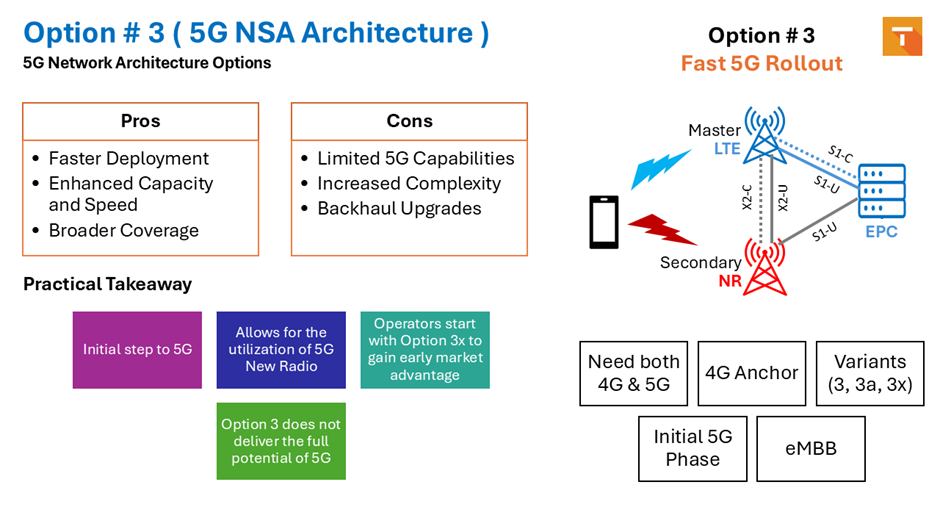
Option 3 is a Non-Standalone (NSA) 5G deployment architecture that leverages existing 4G LTE infrastructure for its core network and control plane, while introducing 5G New Radio (NR) for enhanced data speeds and capacity
This option is widely adopted by operators to quickly introduce 5G services by building upon their established 4G networks

Key Characteristics
NSA Option 3 is a non-standalone configuration, meaning it requires the presence of a 4G LTE network and its core (EPC) to function, rather than operating independently
4G Anchor: . In this setup, the 4G eNodeB (eNB) acts as the Master Node (MN), handling signaling and connecting to the 4G Evolved Packet Core (EPC), while the 5G gNodeB (gNB) serves as a Secondary Node, providing additional bandwidth for user data
Variants (3, 3a, 3x): The Option 3 series includes variants like 3, 3a, and 3x, which differ primarily in how the data split is handled between the 4G eNB and 5G gNB
Initial 5G Phase: It is considered an initial phase of 5G deployment, allowing mobile operators to accelerate time-to-market for new 5G services by leveraging existing infrastructure
Enhanced Mobile Broadband (eMBB): Primarily designed to deliver enhanced mobile broadband services by offloading data traffic to the 5G NR, improving speeds and capacity
Pros of Option 3
Faster Deployment: Allows operators to quickly launch 5G services by leveraging existing 4G infrastructure and core networks, reducing initial investment and time-to-market
Enhanced Capacity and Speed: Provides higher data rates and increased network capacity by adding 5G NR spectrum, improving the user experience for mobile broadband
Broader Coverage: Benefits from the extensive coverage of the existing 4G network, ensuring widespread availability of basic 5G services
Cons of Option 3
Limited 5G Capabilities: Does not fully support advanced 5G features like ultra-low latency, network slicing, or massive machine-type communications, as it still relies on the 4G core
Increased Complexity: Managing dual connectivity between 4G and 5G radio access networks can add complexity to network operations and potentially increase processing load on legacy eNB hardware
Backhaul Upgrades: May require significant backhaul upgrades on LTE sites to handle the increased data traffic from 5G NR
Practical Takeaway
Option 3 is a common initial step for mobile operators to introduce 5G services, particularly for enhanced mobile broadband
It allows for the utilization of 5G New Radio (NR) spectrum and capabilities while relying on the mature and widespread 4G LTE core network
Operators often start with Option 3x to gain early market advantage before transitioning to a full 5G Standalone Option 2 architecture, which offers complete 5G features
While offering benefits in speed and deployment, it's important to recognize that Option 3 does not deliver the full potential of 5G in terms of ultra-low latency or advanced network slicing capabilities.
Option # 3 / 3a / 3x

In Option 3 (NSA 5G), there are three main variants that define how data flows between 4G and 5G while still using the 4G core (EPC). These are Option 3, Option 3A, and Option 3X.
Option 3 : In this setup, both signaling and user data go through the 4G eNodeB first. The 5G gNodeB is mainly used to add extra data capacity. So even if 5G is present, the main path is still controlled by 4G
Option 3a : Here, signaling still goes through the 4G eNodeB, but user data is split at the core (EPC) and sent directly to both 4G and 5G nodes. This reduces load on the eNodeB and improves performance compared to Option 3
Option 3X : In Option 3X, signaling is still controlled by 4G, but most of the user data flows through the 5G gNodeB. This gives better 5G utilization and higher throughput compared to the other two variants. This variant is often preferred as it allows for a dynamic user plane split at the packet level in the RAN, providing better performance and efficiency.
Migration Strategy for 5G Launch
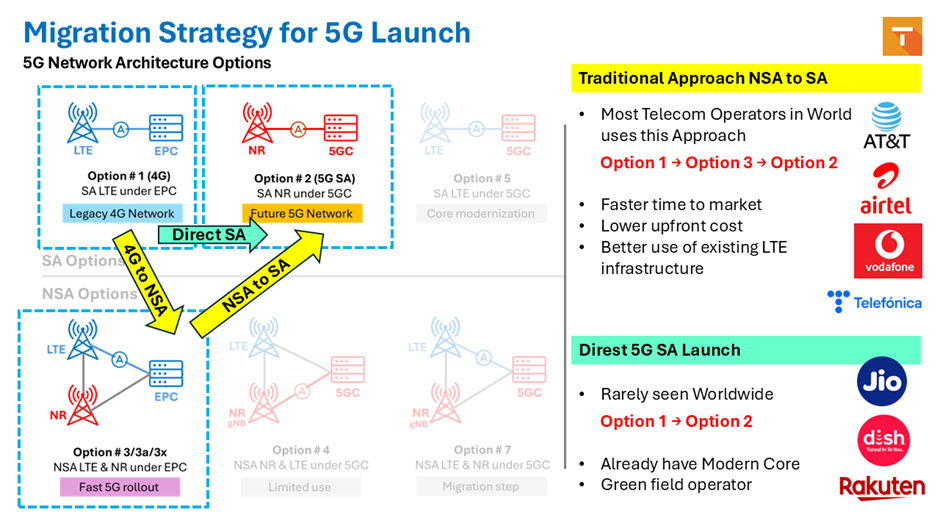
There are 2 Ways how Operator can launch 5G
NSA Option - Traditional Migration Approach for launching 5G
Operator Launch 5G NSA with Option # 3 & then move to Option # 2 Gradually once Core , Radio & Spectrum Ecosystem is in control. Most traditional operators (like Vodafone, AT&T, Telefonica) chose Option 3 (NSA) first because:
Faster time to market - With Option 3, operators don’t need to wait for a full 5G Core deployment, which can take years to design, test, and stabilize. Instead, they simply add 5G radios (gNodeB) on top of existing 4G sites. Since the control signaling still runs on LTE, the network remains stable and proven. This allows operators to switch on 5G in months rather than years, giving customers immediate access to higher speeds and helping operators claim early 5G leadership in the market.
Lower upfront cost - Building a 5G Core (as mentioned in Option 2) is expensive. It requires new cloud-native infrastructure, data centers, orchestration platforms, and skilled teams. On top of that, there are integration and operational costs. Option 3 NSA avoids this initial heavy investment by continuing to use the existing EPC (4G core). This spreads investment over time. Instead of a big upfront cost, operators follow a phased investment model, aligning spending with revenue growth from 5G services.
Better use of existing LTE infrastructure - Operators have already invested billions in LTE infrastructure such as towers, spectrum, fiber backhaul, and core networks. Option 3 NSA allows them to fully leverage these assets instead of replacing them. LTE acts as a strong coverage layer, especially in rural or indoor areas where 5G coverage may still be limited. The 5G layer then adds capacity in high-traffic zones like cities and hotspots.
Direct 5G SA Launch
A few operators have moved almost directly from Option 1 (pure 4G LTE) to Option 2 (Standalone 5G), but it’s the exception, not the norm . Direct Option 1 to Option 2 migration typically happens when:
The operator has a modern, virtualized 4G core
It adopts a cloud-native strategy early
Or it is a greenfield operator where there are no legacy constraints
Direct migration from Option 1 to Option 2 which is direct 5G SA Launch is done by disruptors or digitally native operators. Most incumbents prefer a phased journey through NSA before reaching full Standalone 5G.
Option # 4 , 5 & 7
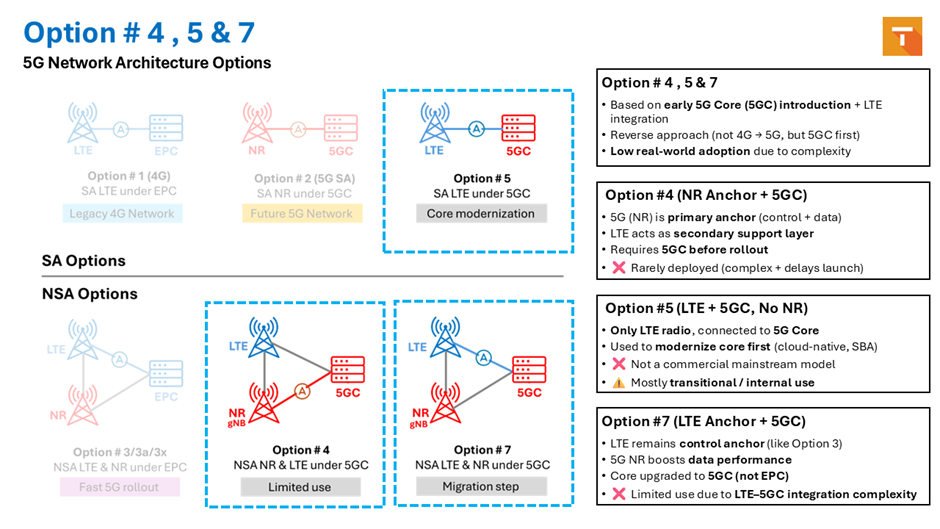
5G deployment Options 4, 5, and 7 come from the same 3GPP framework as the more commonly used Options 2 and 3, but they follow a different migration philosophy. Instead of evolving from a 4G core toward 5G, these options assume that an operator introduces the 5G Core (5GC) early and then integrates LTE around it. Because of this reverse approach, they are far less common in real-world deployments.
What’s common in Option # 4 , 5 & 7
Based on early 5G Core (5GC) introduction + LTE integration
Reverse approach (not 4G → 5G, but 5GC first)
Low real-world adoption due to complexity
Option # 4 Explained
Option 4 can be understood as a reverse version of Option 3. In this setup, the network already has a 5G Core, and the 5G radio (gNodeB) becomes the main anchor for both control and data. LTE is still present, but it plays a secondary role and supports the 5G layer when needed. In simple terms, users are primarily connected to 5G, with LTE assisting in coverage or continuity. While this sounds like a logical forward-looking design, it requires operators to deploy a full 5G Core before large-scale 5G rollout. Most operators avoided this path because it increases complexity and delays initial launch timelines, so Option 4 has seen very limited, if any, commercial adoption.

Key Characteristics of Option # 4
• 5G (NR) is primary anchor (control + data)
• LTE acts as secondary support layer
• Requires 5GC before rollout
• ❌ Rarely deployed (complex + delays launch)
Option # 5 Explained
Option 5 is even more unusual because it involves using LTE radio with a 5G Core, without introducing 5G NR at all. Essentially, it is a 4G access network connected to a modern 5G core network. The idea behind this approach is to modernize the core first, enabling cloud-native capabilities, service-based architecture even before deploying 5G radio. In practice, however, very few operators chose this as a visible commercial strategy. Some may have used similar setups internally or during transition phases, but it has not been widely marketed or recognized as a mainstream deployment model.

Key Characteristics of Option # 5
• Only LTE radio, connected to 5G Core
• Used to modernize core first (cloud-native, SBA)
• ❌ Not a commercial mainstream model
• ⚠️ Mostly transitional / internal use
Option # 7 Explained
Option 7 sits somewhere between Option 3 and Option 2. In this case, LTE still acts as the anchor for control signaling, and 5G NR is added to boost data performance, similar to NSA Option 3. The key difference is that the core network is upgraded to the 5G Core instead of continuing with EPC. This creates a hybrid scenario where LTE anchors the connection, but the backend is already modernized. While this might seem like a smooth transition step, it introduces additional complexity because LTE must now interwork deeply with the 5G Core. Most operators found it simpler either to stay with Option 3 using EPC or to move directly to full Standalone Option 2, which limits the practical use of Option 7.

Key Characteristics of Option # 7
• LTE remains control anchor (like Option 3)
• 5G NR boosts data performance
• Core upgraded to 5GC (not EPC)
• ❌ Limited use due to LTE–5GC integration complexity
Take Away
Overall, Options 4, 5, and 7 are important from a standards perspective because they provide flexibility and theoretical migration paths. However, in practice, they are rarely implemented at scale because they add complexity without offering a strong enough business or operational advantage compared to simpler and more proven deployment strategies.
In real-world deployments, operators such as Vodafone, AT&T, and Telefonica largely avoided these options. They preferred a more straightforward path of moving from Option 1 to Option 3 for quick rollout and then gradually evolving to Option 2 for full 5G capabilities. Even newer or more disruptive players like Dish Wireless , Jio & Rakuten Mobile focused on building Standalone 5G directly rather than adopting these intermediate architectures.
5G Network Architecture Options Explained (Option 1 to Option 7)
Blog # 005


Comments