5G Vs 4G LTE Core Architecture - Layered Design, CUPS & Edge Explained
- Mar 22
- 4 min read
Updated: May 3
5G is not just faster 4G. It changes how the core network is designed and deployed.
5G Core layered architecture explained

On Left Hand Side, this is Typical 4G LTE Core Network – a Traditional Box Driven Architecture. On Right Hand Side, you can see 5G Layered SBA Architecture.
Let's Understand 5G Vs 4G LTE Core Architecture.
If you try to run use cases like smart factories, connected cars, or cloud gaming on a 4G core, you quickly face limits. The architecture was never built for real-time and edge-based applications. That is why 5G moved to a layered, cloud-based design.
Let’s understand this in a simple way.
The Problem with the Old 4G Core

In 4G, the architecture was box-driven and tightly coupled. The eNodeB connected to the MME for signaling. The S-GW and P-GW handled user traffic. The HSS stored subscriber data. The PCRF applied policy rules. Each function was deployed as a dedicated network box or tightly bound virtual appliance.
Control plane and user plane were closely linked. Scaling one often meant scaling the other. Deployments were rigid. Latency optimization was limited.
This design worked well for mobile broadband. But it was not built for edge computing, network slicing, or ultra-low latency services.
Key Limitations:
Rigid architecture
Difficult to scale specific functions
Not suitable for edge deployment
Higher latency for real-time apps
Too many point-to-point connections
What Changed in 5G Core?

5G introduced a layered architecture for the core cloud.
Instead of thinking in terms of network “boxes,” we now think in terms of logical layers. The 5G core is built around three main layers: data layer, control plane, and user plane.
This separation is the foundation of modern 5G deployments.
Layer 1: Data Layer (Network Memory)

The first layer stores subscriber and policy data. In 5G, this is handled by components like UDR (Unified Data Repository) and UDSF. This layer keeps subscriber profiles, policy information, and session-related data. Earlier, this role was played by HSS and policy databases. In 5G, the data layer is more centralized, structured, and cloud-ready.
Think of it as the brain’s memory. It stores everything the network needs to know about users and sessions.
In 5G, the data architecture is more structured, flexible, and cloud-compatible.
Layer 2: Control Plane (Network Brain)

The second layer is the control plane. This is where functions like AMF (Access and Mobility Management Function), SMF (Session Management Function), PCF (Policy Control Function), and NSSF operate. In 5G, the control plane uses Service-Based Architecture (SBA).
Instead of rigid point-to-point signaling used in 4G, network functions communicate using service-based APIs in 5G. 5G Architecture is :-
· Easier to scale
· Easier to upgrade
· More flexible for integration
· The control plane becomes software-driven rather than box-driven.
This makes the core modular, flexible, and easier to scale. Functions can be upgraded, scaled, or deployed independently. It is a major shift from the monolithic 4G control architecture.
Layer 3: User Plane (Data Traffic Handler)

The third layer is the user plane.
This is mainly handled by the UPF (User Plane Function). It processes and forwards actual user data traffic - internet browsing, video streaming, gaming, enterprise applications.
The key innovation here is separation from the control plane. This concept is called CUPS: Control and User Plane Separation.
UPF is responsible for:
· Packet forwarding
· Traffic routing
· Internet access
· Application traffic processing
This is where the real user data flows.
CUPS: The Game-Changer
In practical terms, this means you can place UPFs anywhere in the network. You can deploy them at the central core, at regional data centers, or directly at the network edge.

Why CUPS Matters
In 5G, you can place UPF anywhere which makes it flexible & reduce Latency :-
UPF can be deployed at Central Data Centre
Or , UPF can be deployed at Regional cloud
Or , UPF can be deployed at Edge (near tower) .. Basically CUPS Enables Edge
Practical example : Imagine you are playing an online game.
In 4G: Your data travels far to a central core ( leads to higher delay )
In 5G with edge UPF: Data is processed near you in Edge ( gives lower delay )
That is how latency improves.
This flexibility was not possible in traditional tightly coupled core designs.
Benefits of CUPS:
Lower latency
Better user experience
Flexible deployment
Efficient traffic handling
Independent scaling
Real-world examples of Edge:
Self-driving cars need instant response
Robots in factories cannot wait for cloud delays
AR/VR needs real-time interaction
Gaming needs ultra-low latency
5G architecture supports all of this.
5G - All New Cloud Native Architecture

Another major transformation in 5G core is how network functions are deployed.
Earlier, core networks moved from hardware appliances to virtual machines. That was the first step toward virtualization.
Now, 5G core functions are increasingly container-based and built using microservices. Instead of running large monolithic applications inside VMs, each function is broken into smaller, lightweight components.
This is what we call cloud-native architecture.
Cloud-native design allows faster scaling, automated lifecycle management, better resilience, and improved resource utilization. It also supports advanced automation across the network.
In simple terms, the 5G core behaves more like a modern cloud application than a traditional telecom network.
Key Take Away & What Changed in 5G Core?
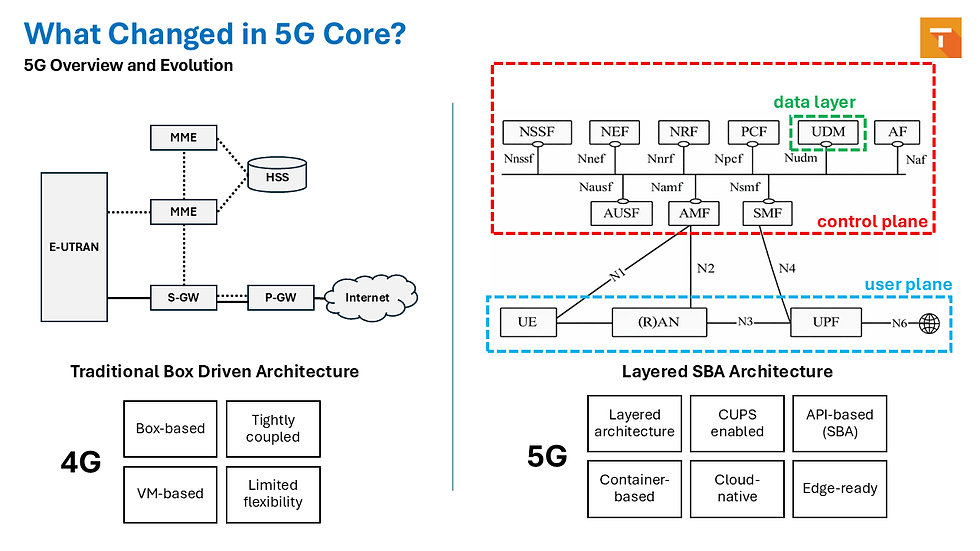
4G vs 5G Core (Quick View)

Key Takeaways
The 5G core is not just an upgrade. It is a full architectural transformation. It introduces layered design, service-based communication, control and user plane separation, cloud-native deployment, and edge flexibility.
5G Core also prepares the network for automation, network slicing, and large-scale scalability :-
5G core is a complete redesign, not just an upgrade
It separates network into Data, Control, and User layers
CUPS allows flexible deployment of user plane
SBA makes the control plane modular and scalable
Edge deployment reduces latency significantly
Cloud-native design enables automation and scalability
5G is built for real-time and industry use cases
Final Thought
4G connected people to the internet.
5G connects industries, machines, and real-time systems.
That shift is only possible because of this new layered core architecture.
4G Vs 5G Core Architecture
Blog # 004


Comments